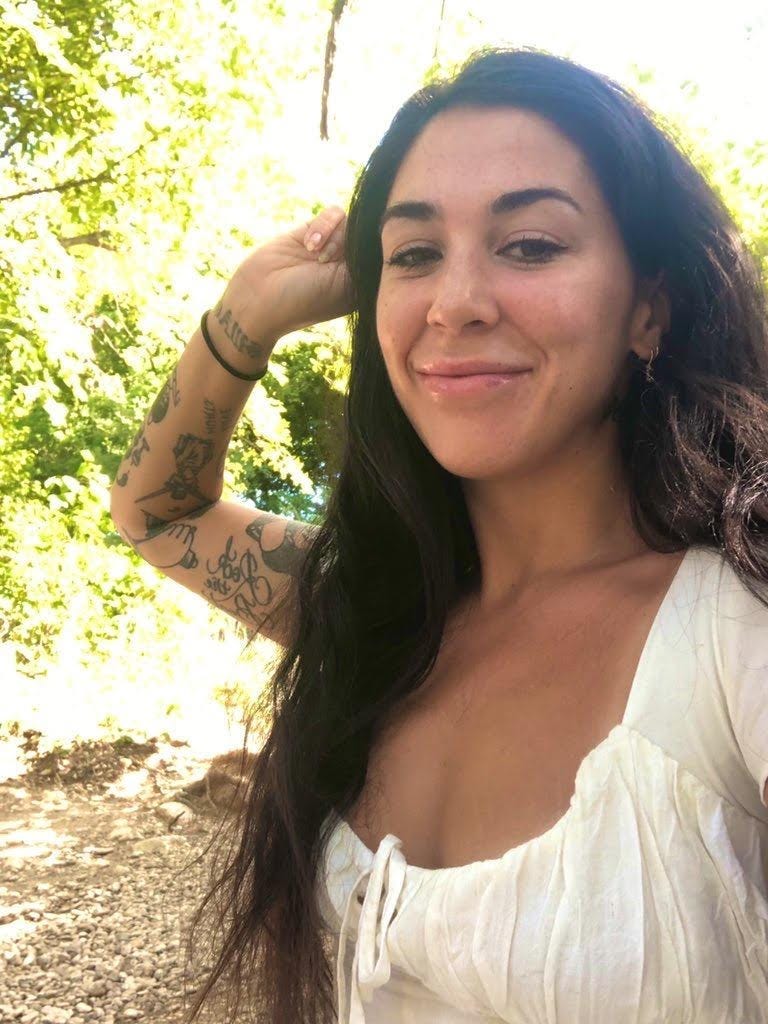
all time is present time: a chat with the writer meaghan garvey
she wrote MIDWESTERN DEATH TRIP, my favorite book this year.

To me it seems like there has been a lot of creation coming out of the Midwest over the past couple of years. Maybe it’s because I’m new to living here so I notice it more, but I do think there is something going on that feels fresh and exciting. Look at Indianapolis, for example. For a while, it wasn’t a city you normally heard about producing cool art, but bands like Wishy and the author Caleb Caudell are putting out awesome stuff by way of independent literature and rock. The binding vibe is an embrace of things that are a little dirty, odd and mundane. The liminal states of Five Below parking lots and dead malls now look beautiful. Everything seems shaded in brown and orange, the colors of stability and warmth.
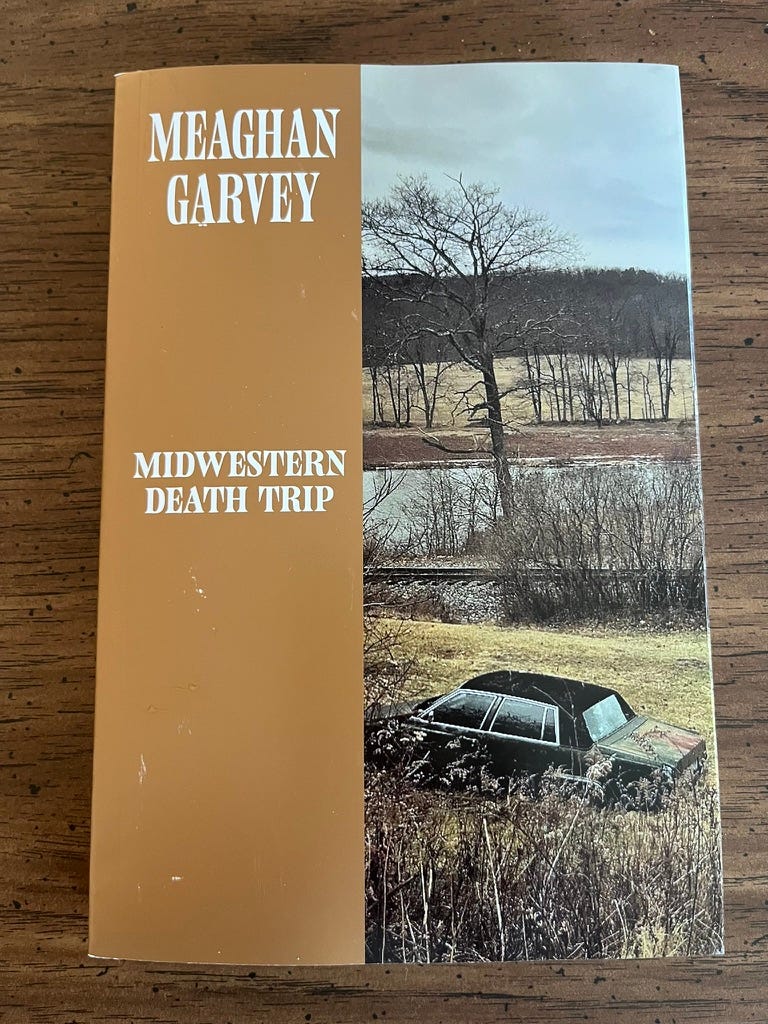
Meaghan Garvey’s MIDWESTERN DEATH TRIP flows from this world, and it’s my favorite book I have read so far this year. Garvey is one of the best writers not just in the Midwest, but in America. Having started out as a music journalist for places like Pitchfork and Vice, the Chicago writer shifted to exploring her home during Covid. There’s a lot of talk about a loneliness epidemic these days, but Garvey navigates one IRL as if the Internet didn’t exist—forging a sort of New American gothic travelogue. She drives for hours alone all day while high on dark-web pills to hang in the lonely bars of Illinois, Wisconsin, and Michigan. The result is a look at a damaged, forgotten America. While the post-2024 Democratic Party spent millions of dollars studying men as if they were some alien species, all it really had to do to start winning was read Garvey’s book.
I said hi to Meaghan last summer during a reading she gave at Chicago’s Quimby’s Bookstore. She was there with the County Highway crew, whose Panamerica imprint published her book this summer. Her writing is so good that her description of the lighting inside a Wisconsin supper club as “somewhere between yuletide and brothel” made me drive three hours to eat there with my wife. When we arrived we were quickly embarrassed at how overdressed we were.
Anyway, I am going to try and highlight some more books coming out of the Midwest. And if you’re in the Los Angeles area, Meaghan will be at Stories on July 1. Below are some questions I asked her over email as she embarked on her book tour. We talk about what drew her to these places, whether the Midwest is making a comeback, Twin Peaks, Dylan, and perspectives on time. I once heard Cass McCombs say that “all time is present time,” or the idea that past and present exist together now in a very visceral way. It’s something that I feel when she writes lines like this about looking at an old photograph from the turn of the 20th century:
“Arranged just so, the faces—unsmiling, wild-eyed, Scandinavian, touched by some obvious madness—convey a collective psyche crisis of the sort I witness regularly on public buses and trains and in the eyes of people who record front-facing videos on their phones.”
Justin: Congrats on the book. And thank you for not setting it in Brooklyn, like so many other millennial books or novels. One reason it stands out, I think, is that it has such a specific sense of regionalism. We’ve been online for too long now. There is no sense of place. But you pass through these forgotten underworlds: the bar in the Seaweed Charlie chapter, comes to mind, or that Illinois ghost town by the Mississippi. I feel like most people, even adventurous writer types or journalists, would enter a room like the one you walk into and then walk right back out, because the people there might seem a little too cooked. But you don’t look down on them. You take them seriously. What makes you comfortable there? And why not enter a Buffalo Wild Wings or something?
Meaghan: The neighborhood tavern in a place like Chicago is like the center of the universe. Maybe it’s like that everywhere but it’s especially like that here, though much less so than it used to be. I want to say there’s about a third as many active tavern licenses in the city now than there were in 1990, and this goes back to Mayor Daley and so on and so forth. But my point is that when I came of age here in this city, I just fell in love with the characters, the camaraderie, and the element of chance that exists only in weird old local dives. And strangely enough, in places like these, I learned how to talk and to listen—to really listen in a way that made people tell you everything. A similar thing was happening in my life as a music journalist—going to famous people’s houses and hopefully earning their trust enough to have a decent conversation. Doing that helped me get over some fears, but those conversations were usually boring compared to the ones I had with strangers in bars.
The simpler answer would be that I am comfortable in these places because we are the same. I may have some artsy-fartsy ulterior motive, but we find ourselves in these places for the same reason. I don’t have a lot of use personally for self-pathology, but by many people’s definition I would fall into the category of an addict, even though my life is, in my opinion, going amazing. And so parallel with whatever curiosity I’m bringing to the situation, there is always this level of commiseration. Everybody here could be drinking at home for cheaper, but instead we’re all here, waiting for something to happen.
J: For sure. I tended bar and waited tables for a while, and I think it definitely helped me come out of my shell. Honestly, it was better than any journalism class I ever took in college, so I’m thankful for that experience.
Your book is also about so much more than hanging out in bars. You weave together a mesmerizing history of the Midwest, incorporating labor, the occult, war, and a strong sense of naturalism and realism. You go deep on the Iron Range and the lumber industry, for example, and I can’t help but think about how much of America was built on the backs of these people. It almost feels like you’re honoring them, or saying goodbye to a certain kind of person.
I know you’ve said you have a hard time explaining what the book is about, but to me it reads almost like a eulogy for the underclass, the working class--whatever you want to call it. I don’t want to just ask, “What does it all mean?” But were these journeys initially as simple as thinking, “This will be weird, and something worth writing about”? In other words, did the project turn out the way you expected, or did it transform into something you didn’t see coming?
M: I try not to overthink my little driving missions; it usually starts with a book I'm reading or an email from a stranger or a weird photo I saw online. Not to sidetrack too far into mystical magical territory, but I think good instincts are as important to a writer as talent and ambition—maybe even more. Anyway, I trust my instincts. So that's a long way of saying that no, I didn't initially imagine that industry would play such a role in the narrative, but it was just inevitable. There's just no way that you can drive around the old copper mining districts of the Upper Peninsula or the Iron Range in northeastern Minnesota and not come to the conclusion that something has gone terribly wrong here in America over the past 50 years with regard to globalization, automation, and what have you. Sometimes you can feel it in the atmosphere, that sense of doom. But at the same time, I'm not big on hand-wringing, and I like to think there's a way to present the reality of neglect and decay side-by-side with the idea that people persist and life goes on. I sort of envision the book as a time-loop in an eternity where everything has already been born and died and then been born again.
J: Speaking of time loops, that brought me back to Twin Peaks and this feeling that everything is connected, even if the connections are hidden most of the time. But sometimes we get a tiny window to see those connections. I thought about that reading the moments in your book where you describe feeling like you were sharing a dream with strangers at a bar, and going to a spiritual retreat in Wisconsin. I had a weird experience once in Cassadaga, apparently the spiritual center in America. The psychic reading itself felt so fake, and I was convinced the place was bullshit. But just as I was leaving I felt this physical shift. I felt weird for hours, and it was like the place was saying, “don’t forget about us.”
Do you ever feel psychically connected to people or places, even after a moment has passed? And when you write about these spirits or hauntings, do those things feel metaphorical to you, or real?
I like to toy around with possibly weird ideas about time and place, and one thing I’ve landed on lately is the idea that where you are is who you are. Maybe you saw that great Bob Dylan interview the other day where he talked about being in his 80s, and in it he said something interesting: “When you’re young you think that time moves forward. At 80 you know that it doesn’t; it stands still. We’re the ones that move.” When you apply a similar logic to places, you start to think that maybe geography is fate—or maybe more like momentum. Some people are moving and some people are staying. This is a roundabout way of saying that when I feel the psychic pull of a certain place, it comes with this pang of guilt as the itinerant person, the one passing through. Cairo, Illinois is a prime example—a place that’s been shaped by neglect for the better half of a century, almost a ghost town, only people still live there. There is an energy in that area that is so viscerally haunted, not by some kind of evil spirit but by its own history. It fucks you up. It has to be real.
J: Someone recently told me that the Midwest is the new America, in terms of affordability and I guess it being a safer haven from the climate crisis. Do you feel this at all?
M: On the one hand, I hope not, though it would be funny to have to “Don’t California My Texas!” all the transplants coming up north. On the other hand, I have noticed “the culture” embracing all things Midwest as of late: supper clubs (or facsimiles of supper clubs) keep opening in cities, there was the Kevin Morby Little Wide Open record, everyone’s wearing Salem merch and dressing like they’re a duck hunter or a union guy when actually they’re a graphic designer. Maybe that’s a recession indicator, or maybe we’re all just yearning for “simpler times.” In any case, I fully endorse the idea of young people moving to Dubuque, Iowa rather than Bushwick.
J: Whatever happened to that dude you dated who was in jail?
M: He wrote a wonderful novel that made him lots of money and set him up to be one of the great writers of our time. He kinda dogged me out but these things happen, especially when you rush a relationship with a guy who spent the last eight years of his life in prison. That was my bad. No regrets. I wish him well.